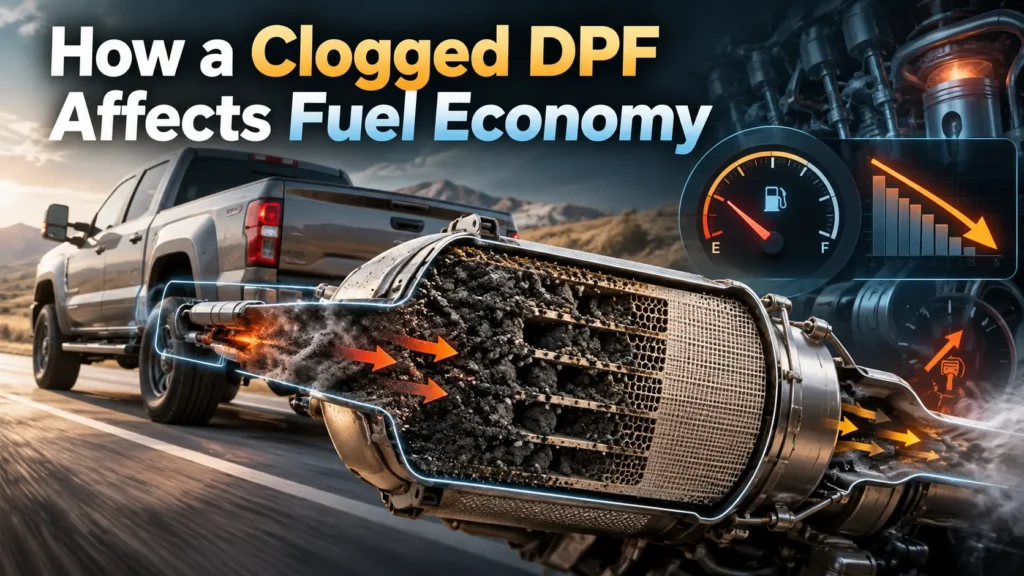
The function of diesel particulate filters is to reduce dangerous particles in diesel emissions. Over time, the filters fill with soot, causing the engine to work harder to maintain its usual performance. In turn, reduced efficiency can worsen emissions and maintenance costs.
Awareness of how clogged DPF fuel economy relates to engine performance can help people identify issues early. This awareness can help save fuel costs and prevent exhaust-system damage. Early detection allows timely service, avoiding larger repairs and unexpected downtime. By understanding the signs, drivers can plan maintenance before problems become severe.
Why Does a DPF Become Clogged?
The DPF captures soot particles from diesel engine exhaust gases before they exit the exhaust pipe. Eventually, soot accumulates in the DPF. In normal circumstances, the vehicle takes care of eliminating the vast majority of the accumulated soot using regeneration.
During regeneration, the system heats exhaust gases to a temperature where accumulated soot burns off.
Various factors can interfere with successful regeneration. Moreover, short-distance driving prevents reaching necessary engine temperatures. These factors may contribute to clogged DPF fuel economy.
Additionally, idling often adds soot. Mechanical issues can also cause excessive soot emissions.
How DPF Blockage Changes Fuel Use
A partially blocked DPF leads to increased exhaust backpressure, implying that the exhaust gas has more challenges to escape the engine. In this way, the engine has to put in more energy to generate the same amount of usable power. It becomes easy to see the link between the efficiency of DPF blockage fuel efficiency, and engine performance when multiple signs emerge.
Nevertheless, fuel efficiency is influenced by various factors other than a DPF. They include tire pressure, driving speed, weather conditions, weight load, traffic, and general engine maintenance.
Common Signs of a Clogged DPF
Several warning signs may appear when a DPF becomes heavily loaded. These signs can vary depending on the vehicle and the severity of the restriction.
Common clogged DPF symptoms
- Reduced engine power during acceleration.
- More frequent regeneration cycles.
- Increased fuel consumption.
- DPF warning lights on the dashboard.
- Higher exhaust temperatures during regeneration.
A vehicle does not need to show every symptom. One sign may appear before others become noticeable. Drivers should also pay attention to changes that happen suddenly. For example, a noticeable MPG decline after repeated failed regenerations can indicate increasing filter restriction.
Can a Blocked DPF Cause an MPG Drop?
Yes, a restricted DPF can contribute to reduced fuel economy.
However, the exact impact depends on the vehicle, engine condition, driving pattern, and blockage severity.
A blocked DPF can reduce MPG because exhaust resistance rises.
The vehicle may also perform more frequent regeneration cycles.
During regeneration, the system uses fuel to raise exhaust temperature and burn accumulated soot.
Factors that can increase fuel consumption
- Frequent short-distance driving.
- Extended engine idling.
- Heavy loads.
- Repeated failed regeneration.
The size of the MPG change can vary significantly. Therefore, one fuel tank is not always enough to confirm a DPF-related problem. If fuel economy continues falling, the DPF system deserves inspection alongside other engine and fuel-system components.
Why Regeneration Matters for Fuel Economy
Regeneration is necessary because a DPF is not able to run endlessly without cleaning up soot build-up in the filter. Usually, a clogged DPF fuel economy system will use the exhaust gas temperature for burning off soot to decrease filter loading. It might happen passively if the exhaust gas temperature becomes too high. It might also happen actively if a higher temperature is required for cleaning the filter.
However, regeneration requires fuel. Thus, constant regeneration might influence fuel consumption. A filter that cannot be regenerated will become more restrictive.
What can interrupt regeneration?
The operation of short journeys can be ended even before the procedure is complete. Regular breaks may hinder stability in operations. Mechanical problems may also inhibit the completion of regeneration. It is important to understand this difference. Failure to do so will only mean that the same problem persists.
How Driving Conditions Affect DPF Performance
Driving behavior may play an important role in DPF loading and fuel efficiency. The exhaust gases generated by diesel engines when traveling at high speeds are usually different from those produced while making many short trips. The payload may also impact the fuel economy.
Driving parameters that may have an effect
- Average length of trips.
- Highway vs city travel.
- Average speed.
- Payload weight.
- Idle time.
- Regeneration frequency.
- Temperature fluctuations depending on season.
All of these parameters could explain fuel economy variations. Nonetheless, the fuel economy drops with the corresponding DPF messages and reduced performance requires closer inspection.
How a DPF Problem Can Affect Engine Performance
A heavily restricted DPF can affect more than fuel consumption. Increased exhaust backpressure can influence how efficiently the engine moves exhaust gases. A blocked DPF MPG drop may therefore appear alongside performance problems. Drivers may notice higher fuel use while the vehicle struggles on hills or during acceleration.
Other possible performance changes
Reduced power
Restricted exhaust flow can make the engine feel weaker, especially under heavy load.
More frequent warnings
Dashboard warnings may appear when the system detects excessive soot loading or regeneration problems.
Reduced operating efficiency
The engine may use more fuel while producing less useful power.
These symptoms can have other causes as well. Turbocharger issues, fuel-system faults, sensors, and air restrictions can create similar problems.
Protecting Fuel Economy Through Proper Maintenance
Correct maintenance procedures can help to minimize the risk of serious DPF clogging. Engine performance is very important in this context since poor combustion will generate more soot. The right fuel and proper engine oil are necessary. Diesel engines with DPF blockage fuel efficiency systems usually need special oil as per manufacturer’s recommendations. Otherwise, ash deposits will accumulate faster.
An informative maintenance record should consist of:
- Fuel economy.
- Frequency of regeneration.
- Indicators on the dashboard.
- Changes in engine performance.
All this information can be helpful for diagnostics. It is not only about improving the MPG. It is also about proper engine performance and avoiding unnecessary repair work.
Understanding the Bigger Picture
The efficiency of fuel depends on a number of systems; hence the issues of the DPF should be considered within the system of the whole vehicle. The filter may be clogged due to an excess of soot, and the excess of soot can be caused by some other malfunction in the engine. Thus, a blocked DPF MPG drop replacement without detecting the cause will not be efficient.
Complete diagnosis includes:
- Soot and ash build-up on the DPF.
- History of DPF regeneration.
- Exhaust gas back pressure.
- Engine malfunction codes.
Such a diagnostic will help distinguish a true DPF restriction from other reasons of fuel inefficiency. It is especially important to have a professional diagnosis when there is more than one sign of problem.
Better Fuel Economy Starts With Understanding the Cause
The use of DPF is essential in the current diesel exhaust control process. However, the state of the DPF can influence fuel consumption and engine operation as accumulation of soot will lead to more exhaust restriction. When dealing with diesel vehicles for commercial purposes, companies should also be considered.
FAQs:
Can a clogged DPF reduce fuel economy?
Yes. A restricted DPF can increase exhaust backpressure and trigger more frequent regeneration, which may increase fuel consumption.
Can a DPF problem cause poor acceleration?
Yes. Severe restriction can increase exhaust backpressure and reduce engine performance, particularly during acceleration or heavy loads.
Does highway driving help prevent DPF problems?
Longer steady drives can support normal regeneration because exhaust temperatures may reach suitable levels more consistently.
What are common DPF blockage warning signs?
Common signs include reduced power, frequent regeneration, warning lights, higher fuel use, and changes in exhaust system behavior.
Should every MPG drop be blamed on the DPF?
No. Tires, payload, traffic, weather, engine problems, driving habits, and maintenance can also affect fuel economy.